TL;DR: The headline EPS number in an earnings release is priced in within seconds. The real signal lives in the call transcript: management tone, Q&A dynamics, language shifts versus prior quarters, and what the company stops talking about. This guide covers the structured workflow buy-side analysts use to read transcripts, the seven red flags that consistently precede negative surprises, and how AI tools like NowNews' Deep Analysis surface these signals at scale across a portfolio.
If you want to test AI-powered earnings call analysis on a real transcript, start a free 7-day NowNews trial no credit card required.
Earnings calls are where most of the qualitative signal in a quarter actually lives, and they are where most retail investors leave value on the table. The numbers in the press release matter, but they are public information within seconds and priced almost as fast. The call transcript, by contrast, contains 45 to 90 minutes of management commentary, analyst questions, and the way executives respond to pressure. That content is harder to extract, which is precisely why it remains a source of edge for analysts who read it well.
Industry data from sentiment-analysis providers like Alexandria Technology has repeatedly shown that defensive language, hedging tone, and uncertainty in management remarks correlate with negative subsequent price action even when reported results meet or beat expectations. Stocks fall on language as much as on numbers. The corollary: investors who systematically extract qualitative signal from transcripts have an information advantage over those who only read the headline.
This guide is the workflow that buy-side analysts actually use. It is structured, repeatable, and designed for retail investors and small-fund analysts who want professional-grade transcript analysis without spending 4 hours per call.
Why earnings calls move stocks more than earnings reports
The earnings report contains the numbers. The earnings call contains the explanation, the forward guidance, the risk acknowledgments, and the Q&A that pressure-tests management. Markets price the report in the first 10 to 30 seconds after release. They reprice repeatedly throughout the call as new commentary changes the picture.
Three reasons calls have outsized impact:
Forward guidance lives in the call, not the release. The press release usually contains a guidance number; the call contains the texture of that guidance. Management can technically maintain guidance while introducing language that signals reduced confidence. A widened guidance range, an extra "subject to macro conditions" qualifier, or a refusal to commit to specific drivers are all guidance changes hidden in plain sight.
The Q&A reveals what the prepared remarks omit. Analysts at Wall Street firms ask the questions management did not preempt. The way executives respond, with or without specifics, with or without pivots back to canned messaging, is the most informative portion of the call.
Language shifts compound across quarters. A single hedging word does not move a stock. A pattern of three consecutive calls showing increasing defensiveness on a specific metric is a leading indicator of guidance cuts, asset writedowns, or executive turnover.
For a structured comparison of platforms that automate this kind of analysis, see our best earnings report analysis platforms guide.
The seven elements buy-side analysts actually track
Reading an earnings call transcript productively means knowing where to look. The following seven elements cover the large majority of actionable signal in any call.
1. Prepared remarks: what is emphasized and what is buried
Management controls the prepared remarks section completely. Every word is reviewed by IR, legal, and the executive team. Nothing in this section is accidental.
The interesting reading is structural. What does the CEO open with? What gets the longest paragraph? What is buried near the end? A company that opens with revenue growth and buries margin compression is signaling priorities and concerns. A company that previously opened with subscriber metrics but now opens with "AI strategy" has shifted its narrative for a reason.
Compare the prepared remarks against the prior quarter. Most CEOs have rhetorical patterns. Departures from those patterns are deliberate.
2. Q&A dynamics: which questions get specific answers and which do not
The Q&A is the live test of management credibility. Analyst questions probe the gaps between headlines and reality. The diagnostic is not the question itself; it is the response.
Three response patterns matter:
Direct numerical answers with specifics build credibility. "Revenue from segment X grew 12% year over year, driven by 8% volume growth and 4% price." This kind of answer signals management knows the business and is comfortable disclosing detail.
Pivots back to prepared talking points signal evasion. When a specific question gets a generic answer that mirrors the prepared remarks, management is avoiding the actual question. Note which topics produce these pivots; they are the ones being protected.
Repeated questions are the strongest signal. If three different analysts ask about the same topic in the Q&A, the buy-side has identified a concern the prepared remarks did not address adequately. The topic is a market concern, regardless of how management responds.
3. Language shifts versus prior calls
This is where AI assistance pays off most. The same metric described as "robust" last quarter and "solid" this quarter has been quietly downgraded. "Strong customer demand" becoming "stable demand" is similar. Adjectives are how management signals direction without committing to a directional change.
Specific shifts buy-side analysts track:
- Confidence words: "expect" → "anticipate" → "hope to" → "are working to"
- Performance descriptors: "exceptional" → "strong" → "solid" → "in line with our expectations"
- Customer language: "robust pipeline" → "healthy pipeline" → "adequate pipeline" → "we remain optimistic about the pipeline"
- Macro framing: macro headwinds becoming a featured talking point that was not in prior calls is a major signal
A single shift may be noise. Three consecutive calls showing the same direction of shift is a trend.
4. Guidance framing and credibility
Guidance is more than a number. It is also a range, a structure, and a set of qualifications.
Range width matters. A narrowed guidance range signals confidence; a widened range signals uncertainty. Management widening a range while maintaining the midpoint is hedging.
Withdrawal of full-year guidance is a major red flag. Companies that withdraw guidance "given macro uncertainty" usually have specific operational issues they are not yet ready to disclose. Macro uncertainty rarely affects a single company in a sector enough to require guidance withdrawal.
Reaffirmed guidance with new qualifications is also a signal. If guidance is unchanged but the company adds "subject to continued strength in [specific area]" or "assuming current macro conditions persist," management has identified a vulnerability they want to flag without revising.
Credibility across calls. Track whether management hits the guidance they set previously. A management team that consistently lands within their guided range is credible; one that frequently revises is not. Build a personal credibility score for the management of any company you follow.

5. Capital allocation signals
What management does with cash reveals their actual view of the business. Statements about buybacks, dividends, M&A, capex, and debt are concrete commitments that contradict or confirm the rest of the narrative.
Buyback execution well below authorized pace despite a "compelling valuation" narrative is a contradiction. Management that says the stock is undervalued but is not buying back is signaling something.
Dividend changes are among the strongest capital-allocation signals. Initiation suggests confidence; suspension or cut signals serious problems regardless of stated rationale.
Capex guidance reveals expected business intensity. A company guiding to lower capex while claiming strong demand is either confident in efficiency gains or quietly signaling slowing growth.
M&A language: a company that frequently mentions "opportunistic M&A" but never executes is using M&A language as cover for organic-growth concerns.
6. What is missing or no longer mentioned
Sometimes the strongest signal is absence. Metrics that featured prominently in prior calls and have disappeared this quarter are usually disappearing because they are no longer flattering.
Examples buy-side analysts watch for:
- Specific customer counts replaced with generic "growing customer base" language
- Cohort retention numbers stopping mid-quarter when they were a feature of every prior call
- Geographic breakdown removed when it was previously a highlight
- Specific margin targets replaced with "we are committed to long-term margin expansion"
This is the "metric substitution" pattern: a specific metric replaced with a vague one. It is one of the most reliable predictors of operational deterioration.
NowNews Deep Analysis is built around this kind of cross-quarter comparison: it ingests transcripts, identifies which language and metrics changed, and flags substitution patterns automatically.
7. Risk disclosures and forward-looking statements
The risk language at the start and end of the call (the safe-harbor statement and any acknowledged risks during the call) is often longer and more specific when management has identified emerging issues. Boilerplate risk language is consistent across quarters; expanded or more specific risk language is informative.
Watch for new risk factors that were not in prior calls. A risk factor mentioned for the first time is usually mentioned because it has become material. Companies do not preemptively disclose risks that are not relevant; lawyers do not let them.
The seven red flags that precede negative surprises
Beyond the structural elements above, certain specific patterns consistently precede negative price action in subsequent quarters. The buy-side equivalent of "smoke before fire" includes:
Metric substitution. A specific metric in prior calls is replaced with a vague one. Often precedes that metric deteriorating in the following quarter.
Deflected analyst questions, especially when asked twice. When the same question gets asked a second time and is still avoided, management is protecting something.
Macro headwind narrative emerging suddenly. When macro conditions did not exist as a talking point last quarter and dominate this quarter, management is using macro as cover for execution issues. If competitors do not cite the same macro factors, the headwind is internal.
Guidance range widening without explanation. Wider ranges signal uncertainty, especially when prior calls had narrower ones. The widening itself is the signal.
Withdrawal of full-year guidance. Almost always signals an unresolved issue management is not ready to disclose.
Cost-cutting framed as "optimization" rather than disclosed as headcount reduction. Vague cost-control language usually precedes specific layoffs in later quarters.
Notably shortened Q&A session. When IR cuts off Q&A early or fewer analysts get to ask questions, management is reducing exposure to scrutiny. This often correlates with calls management wanted to control tightly.
Three or more of these patterns appearing in a single call should trigger a re-evaluation of the position. They do not guarantee a negative outcome, but they reliably increase the probability.
If you want to skip the manual reading and let AI surface these patterns automatically, NowNews offers a 7-day free trial with full access to Deep Analysis on transcripts.
A repeatable workflow for analyzing any earnings call
The buy-side standard is roughly 45 to 60 minutes per transcript. The following workflow is what gets you there efficiently:
Step 1 — Pre-call preparation (10 minutes): Pull up the press release, the prior call transcript, and the consensus expectations. Note the metrics most likely to be debated. Have a personal checklist with the seven red flags above.
Step 2 — Headline numbers vs expectations (5 minutes): Compare reported numbers to consensus. The gap, not the absolute number, is what determines the price reaction. If revenue beat by 2% but EPS missed by 5%, the call is probably going to focus on margin.
Step 3 — Prepared remarks read with prior call open (15-20 minutes): Read the new prepared remarks side by side with the prior call's prepared remarks. Note structural changes (what is emphasized, what is buried), language shifts, and any metrics that have appeared, disappeared, or been substituted.
Step 4 — Q&A dynamics (15-20 minutes): Read the Q&A. Note which questions got direct answers and which got pivots. Mark any topic asked about by multiple analysts. Note Q&A length: significantly shorter than usual is itself a signal.
Step 5 — Cross-check against the financials (5-10 minutes): Verify the management narrative against the actual numbers. If management claims "strong demand" but inventory is rising and DSO is extending, the narrative is contradicting the data. This is where honesty signals come from.
Step 6 — Update your conviction (5 minutes): Decide whether the call increases, maintains, or decreases your conviction in the position. Write the reason in one sentence. This forces explicit thinking and creates an auditable record across quarters.
For a single name with no red flags, this workflow takes 45-60 minutes. With three or more red flags, it can take 90 minutes including the cross-checking. Across a 10-name portfolio with quarterly calls, that is 30-40 hours per earnings season per analyst.
Common mistakes that ruin earnings call analysis
A few patterns produce most avoidable misreads:
Reading the transcript without the prior one open. A new transcript in isolation tells you what management said. The interesting reading is what changed, which requires the prior call as reference.
Overweighting the headline EPS. EPS is one signal among many. Companies that beat EPS but reduce guidance, widen guidance ranges, or use defensive language often fall harder than companies that miss EPS but raise guidance and convey confidence.
Taking management's narrative at face value. Executives are professional communicators. The job of the analyst is to verify the narrative against the financial data. When narrative and numbers diverge, trust the numbers.
Skipping the Q&A. The prepared remarks are management's controlled message. The Q&A is where analysts test that message. Skipping the Q&A means skipping the most diagnostic 30 to 45 minutes of the call.
Ignoring tone in favor of "just the facts." Tone is the leading indicator. Numbers are the lagging indicator. By the time the numbers reflect a problem, tone has often signaled the problem two or three quarters earlier.
Reacting to a single transcript. One quarter is data. Patterns require multiple quarters. Build a multi-quarter view of any name you care about before drawing strong conclusions from a single call.
How AI changes earnings call analysis
The buy-side standard of 45 to 60 minutes per transcript per quarter is feasible for an analyst covering 5 to 10 names. It does not scale beyond 20 names. This is where AI changes the workflow rather than replacing it.
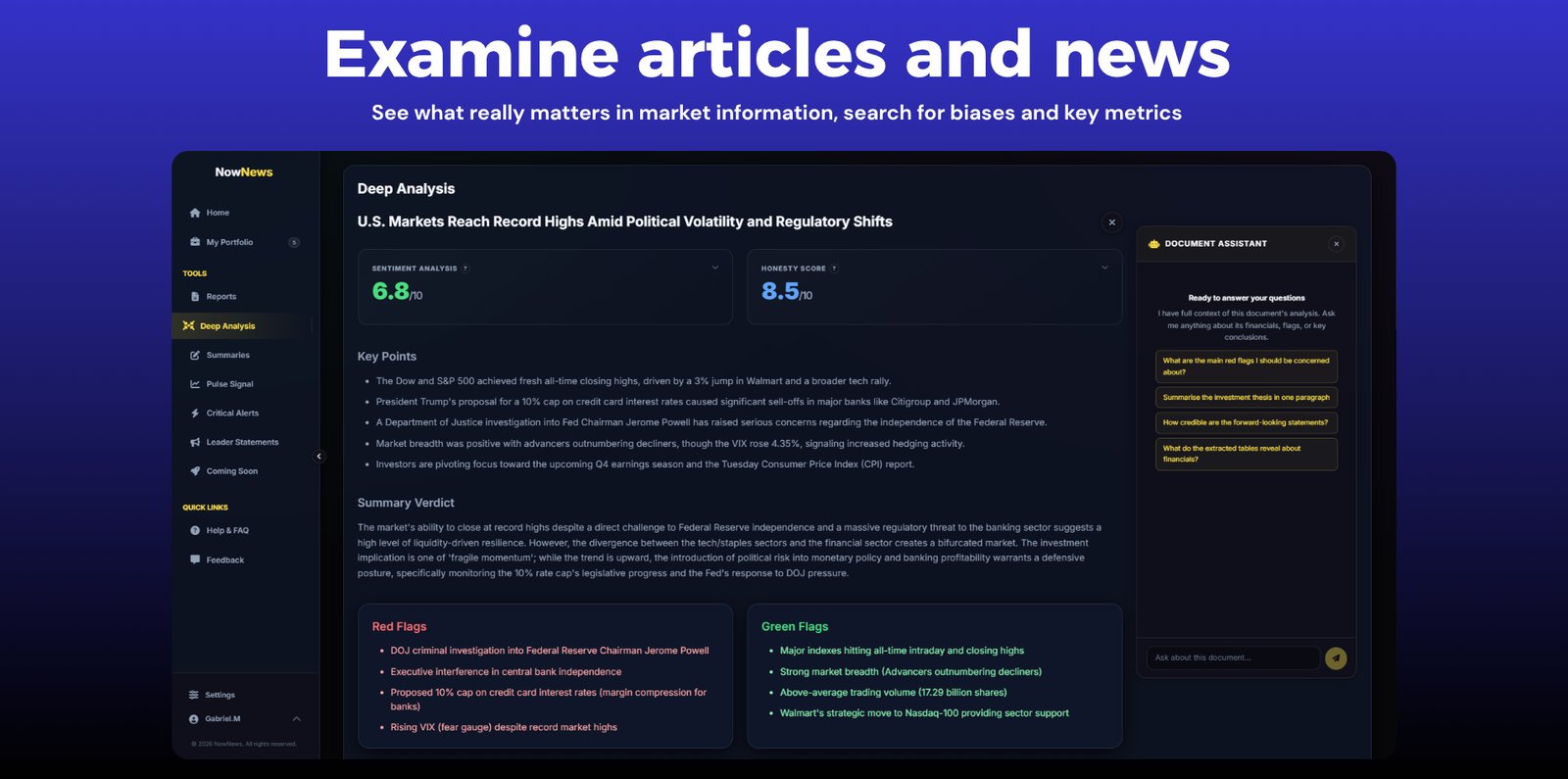
AI-powered transcript analysis tools, including NowNews' Deep Analysis and platforms like AlphaSense and Hebbia, automate four specific tasks:
Cross-quarter language diff. Instead of manually reading the new and prior transcripts side by side, the AI surfaces every meaningful language change with directional scoring. The analyst then validates the changes that matter.
Sentiment and tone scoring. Models trained on financial language (FinBERT and successors) score each section of the call on a confident-to-defensive scale. Aggregate score shifts across calls are leading indicators that compound across quarters.
Honesty signal detection. The system flags contradictions between narrative claims and underlying numbers. A claim of "strong margin trajectory" alongside actual margin compression is exactly the kind of inconsistency AI detects reliably.
Q&A pattern analysis. AI can quantify how many analyst questions got direct numerical answers versus pivots, identify repeated topics, and measure Q&A length compression. These are objective measures of management transparency that no human reads consistently across 50 calls per quarter.
The combination of structured manual reading (using the workflow above) and AI-assisted diff and sentiment analysis is what professional buy-side desks actually use now. The AI does not replace the analytical thinking; it makes the mechanical comparison faster and more consistent across the portfolio. Tools like NowNews are built around this hybrid model: AI surfaces the signals, the analyst makes the judgment.
Frequently asked questions
What is the difference between an earnings report and an earnings call?
The earnings report is the press release containing the financial results: revenue, EPS, margins, balance-sheet metrics, and any forward guidance. It is released before the call. The earnings call is a live conference call (45 to 90 minutes) in which executives present the results, discuss the business, and take questions from sell-side analysts. The report contains the numbers; the call contains the explanation, the forward narrative, and the Q&A that tests management's credibility. Both move stocks; the call typically produces more sustained moves because of the qualitative information it adds.
How long does it take to analyze an earnings call transcript properly?
A buy-side standard is 45 to 60 minutes per transcript when no red flags are present, and up to 90 minutes when multiple red flags require cross-checking against the financials. This includes pre-call preparation (10 minutes), reading prepared remarks against the prior call (15-20 minutes), reading the Q&A (15-20 minutes), and cross-checking the narrative against financials (5-10 minutes). Across a 10-name portfolio with quarterly calls, that is 30 to 40 hours per earnings season per analyst. AI tools like NowNews Deep Analysis reduce this significantly by automating the cross-quarter comparison and surfacing language shifts.
What are the most reliable red flags in an earnings call?
The most reliable red flags are: metric substitution (a specific metric replaced with a vague one), deflected analyst questions especially when asked twice, sudden macro headwind narrative when prior calls did not feature it, guidance range widening without explanation, withdrawal of full-year guidance, cost-cutting framed as "optimization" rather than disclosed as headcount reduction, and notably shortened Q&A sessions. Three or more in a single call should trigger position re-evaluation. None individually guarantees a negative outcome, but each meaningfully increases the probability of guidance cuts or operational issues in subsequent quarters.
Can AI accurately read management tone on earnings calls?
AI is reliable for specific tasks: comparing language between transcripts, scoring tonal shifts on a confident-to-defensive scale, and flagging contradictions between narrative and numbers. The 2025 academic literature on financial language models (FinBERT and successors) shows tone scores correlate meaningfully with subsequent price action. AI is less reliable for sarcasm, technical jargon specific to a niche, or culturally specific phrasing. The practical use is as a first-pass layer that surfaces interesting changes, with human validation for the final interpretation.
What is "metric substitution" and why does it matter?
Metric substitution is when a company replaces a specific metric featured in prior calls (e.g., "active subscribers grew 18% year over year") with a vague metric (e.g., "we continue to see healthy customer engagement"). This pattern often precedes deterioration in the underlying metric. Companies do not bury good news; if a specific number disappears, the underlying number is usually no longer flattering. Tracking metric substitution across quarters is one of the highest-precision red flags in earnings call analysis.
Should I listen to the call live or read the transcript afterward?
Reading the transcript afterward is more productive for almost all retail and small-fund analysts. Live calls are unstructured; transcripts allow you to read the prepared remarks against the prior call, mark Q&A patterns, and cross-check against the financials at your own pace. The exception is when you are trading the immediate price reaction, in which case live audio matters because tone shifts in voice (pace, hesitations) sometimes precede the equivalent textual signals. For non-trading analysis, the transcript wins on consistency and depth.
Does NowNews analyze earnings call transcripts?
NowNews Deep Analysis ingests earnings call transcripts and applies sentiment scoring, honesty signal detection, key point extraction, and a chat interface for asking specific questions about the content. It compares language across quarters when prior transcripts are available. The 7-day free trial includes full access to Deep Analysis without a credit card.
How do I track management credibility across quarters?
Build a simple personal scorecard for each company you follow. After each quarter, note: did management hit the guidance they set previously, did Q&A answers turn out to be accurate in retrospect, did stated risks materialize or remain hypothetical. Over four to six quarters this scorecard reveals which management teams are credible communicators (their language is reliable) and which are not (their language is unreliable, requiring heavier discount). This personal credibility model is one of the highest-leverage research investments you can make on names you hold long-term.
The bottom line
Earnings call transcripts are where most of the qualitative signal in a quarter actually lives, and most retail investors leave that signal on the table. The seven elements buy-side analysts track (prepared remarks structure, Q&A dynamics, language shifts, guidance framing, capital allocation, what is missing, risk disclosures) form a repeatable framework that can be applied to any call. The seven red flags (metric substitution, deflected questions, sudden macro narrative, guidance widening, guidance withdrawal, vague cost cutting, shortened Q&A) reliably precede negative price action.
Doing this manually takes 45 to 60 minutes per call. AI-powered tools like NowNews' Deep Analysis handle the mechanical comparison automatically, surfacing language shifts, scoring tone, and flagging narrative-data contradictions, so the analyst can focus on judgment instead of transcript reading.
If you want to see AI-powered earnings call analysis in practice, NowNews offers a 7-day free trial of the full platform. Try it on a transcript you already know well and compare the AI summary against your own read.
This article is updated as earnings-call patterns evolve. Last reviewed: April 2026. Have an earnings call case you think should be discussed? Contact us.