TL;DR: Most market alert tools are too noisy to be useful — they fire on every mention of a ticker. The good ones filter for actual market-moving events. We tested 8 platforms and ranked them by signal-to-noise ratio, not by feature count.
The dirty secret of stock alerts is that most of them make you a worse investor. They fire constantly on irrelevant news, train you to react instead of think, and create the false sense that "being notified" equals "being informed."
A genuinely useful alert system does the opposite. It stays silent 99% of the time. When it does fire, it's because something actually happened that affects your positions or watchlist — not because a journalist mentioned a ticker in a roundup article.
This guide compares the 8 most relevant alert platforms in 2026, ranked by how well they filter signal from noise.
What separates a good alert system from a noisy one
Before the list, here's what we evaluated:
- Filtering quality — does it fire on every mention, or only on material events?
- Speed — alerts within seconds of an event, or minutes/hours later?
- Customization — can you set rules per asset, per impact level, per source?
- Channels — push notifications, email, SMS, webhook, Slack?
- Coverage — stocks only, or also forex, crypto, commodities, macro?
- Free tier availability — can you test it without committing?
- Price — accessible to individuals, or enterprise-only?
The biggest differentiator turned out to be filtering quality. The best platforms scored events by impact and only alerted on the high-impact ones. The worst sent dozens of alerts per day, training users to ignore them.

The 8 best alert platforms
1. Dataminr
Dataminr is the institutional standard for early event detection. It processes social media, news wires, sensor data, and public records to identify market-moving events often before mainstream media reports them.
Best for: Hedge funds, prop trading desks, and institutional investors who need the earliest possible signals.
Strengths: Extremely fast event detection, multi-source data fusion, deep customization of alert rules.
Limitations: Enterprise-only pricing. Designed for sophisticated users — the configuration is complex.
Pricing: Custom enterprise pricing, typically tens of thousands per year.
2. NowNews Critical Alerts
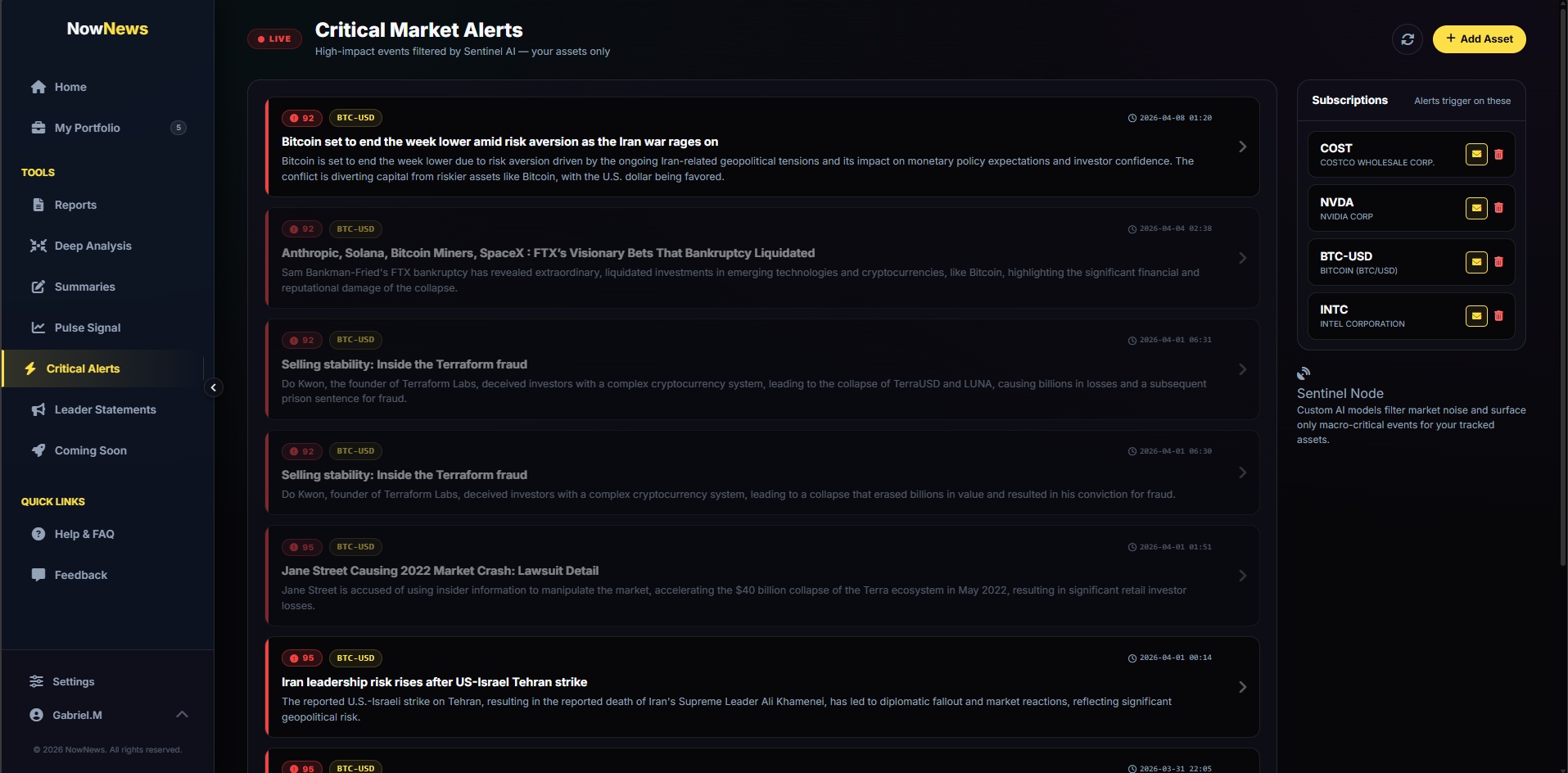
NowNews takes a different approach: instead of trying to be the fastest, it focuses on being the most relevant. Its Sentinel AI filters thousands of news items per day and only surfaces ones that meet specific impact thresholds — measured by sentiment magnitude, source authority, and asset relevance.
Best for: Independent traders, advisors, and analysts who want intelligent alerts without enterprise complexity.
Strengths:
- Filters for high-impact events only, not every mention
- Cross-references news with the assets in your watchlist
- Includes impact direction analysis (bullish/bearish) and time-horizon estimates
- Email and dashboard notifications
- Works for stocks, ETFs, crypto, and macro events
Limitations: No SMS or push notifications yet (web/email only). Currently no webhook integration.
Pricing: Included in NowNews subscription at €24.99/month (early adopter pricing €14.99/month). 7-day free trial.
3. Bloomberg Terminal Alerts
Bloomberg's alert system is part of the broader terminal product. It's deeply integrated with market data and news, which makes it powerful for users who already have Bloomberg.
Best for: Existing Bloomberg users at institutions.
Strengths: Tightly integrated with everything else Bloomberg offers, very customizable, real-time across all asset classes.
Limitations: Only available as part of the full terminal subscription.
Pricing: ~$2,000/month per terminal.
4. TradingView Alerts
TradingView is primarily a charting platform, but its alert system is one of its most-used features. Alerts can be set on price levels, technical indicators, or custom strategy conditions.
Best for: Technical traders who base alerts on chart patterns and indicator triggers.
Strengths: Free tier available, excellent customization for technical alerts, multiple channels (email, SMS, webhook).
Limitations: Focused on price/technical alerts, not on news or fundamental events. Free tier limits the number of active alerts.
Pricing: Free tier (limited alerts), paid plans from $14.95/month.
5. Benzinga Pro
Benzinga Pro provides real-time news with audio squawk and customizable alerts. Popular with day traders for its breaking news speed on US stocks.
Best for: Active US stock traders who want breaking news fast.
Strengths: Fast news ingestion, audio alerts during the trading day, good filtering by sector and event type.
Limitations: US stocks focus, subscription is relatively expensive for individuals.
Pricing: Starts around $99/month for the basic tier.
6. Stock Titan ARGUS
ARGUS is Stock Titan's momentum scanner that detects unusual stock movement backed by breaking news. When a stock starts moving with news as a catalyst, ARGUS sends an alert.
Best for: Momentum traders looking for news-driven breakout opportunities in US stocks.
Strengths: Free tier, real-time momentum detection, news correlation built in.
Limitations: US stocks only. Focused on momentum/breakout strategies, less useful for long-term investors.
Pricing: Free tier with paid upgrades.
7. Google Alerts
The free baseline. Google Alerts sends you an email when new content matching your search query is indexed. It's not built for finance, but it works for basic monitoring of company names or topics.
Best for: Anyone who wants free, basic monitoring without sophisticated filtering.
Strengths: Free, simple, works for any topic.
Limitations: Slow (often hours behind), no impact filtering, no financial context. Will alert you on a random blog mentioning a ticker.
Pricing: Free.
8. Finviz Elite Alerts
Finviz is a stock screener with alert functionality on its premium tier. Alerts can be set on screener criteria, technical patterns, or news events.
Best for: Investors who use Finviz for screening and want alerts on the same platform.
Strengths: Integrates with Finviz's screening tools, good for setting alerts on technical or fundamental criteria changes.
Limitations: US stocks focus, news alerts are basic compared to dedicated tools.
Pricing: $39.50/month for Elite tier.
Comparison table
| Platform | Filtering | Speed | News alerts | Price alerts | Free tier | Price |
|---|---|---|---|---|---|---|
| Dataminr | ● | ● | ● | ◐ | ○ | $$$$ |
| NowNews | ● | ◐ | ● | ◐ | ● (trial) | $ |
| Bloomberg | ● | ● | ● | ● | ○ | $$$$ |
| TradingView | ◐ | ● | ○ | ● | ● | $-$$ |
| Benzinga Pro | ◐ | ● | ● | ◐ | ○ | $$ |
| Stock Titan | ◐ | ● | ● | ◐ | ● | Free/$ |
| Google Alerts | ○ | ○ | ◐ | ○ | ● | Free |
| Finviz Elite | ◐ | ◐ | ◐ | ● | ○ | $ |
● = Strong ◐ = Partial ○ = Not a feature
Which platform should you choose?
The right alert platform depends mostly on what you're alerting on and how active your trading style is.
If you're an institutional investor with budget: Dataminr or Bloomberg. Dataminr if speed of event detection is the priority. Bloomberg if you need full integration with execution and data.
If you're an independent trader or analyst: NowNews Critical Alerts gives you intelligent filtering at an accessible price. The Sentinel AI's signal-to-noise ratio is the main reason to choose it over cheaper alternatives that just forward every news item.
If you trade based on technical patterns: TradingView is hard to beat. The alert system on chart patterns and indicators is best-in-class for technical trading.
If you're a US momentum day trader: Benzinga Pro for breaking news speed, or Stock Titan ARGUS for free momentum detection.
If you just need basic free monitoring: Google Alerts works as a starting point, but expect noise. Upgrade as soon as you start ignoring most alerts.
How to set up alerts that you'll actually use
Regardless of which platform you choose, the most common alert mistake is creating too many. Here's a discipline that prevents alert fatigue:
Set alerts only for assets you actually own or are seriously considering. Not for assets you find interesting. The watchlist should match the portfolio decisions you'd actually make.
Use impact filters wherever possible. If the platform offers a "high impact only" setting, use it. If it doesn't, manually narrow the alert criteria to the most material events (earnings, M&A, regulatory changes, guidance updates).
Audit your alerts monthly. Look at the alerts you received in the last 30 days. For each one, ask: did I take action because of this? If you didn't act on 90%+ of your alerts, your filtering is too loose.
Limit alert channels. Pick one primary channel (email or push) and stick with it. Multiple channels create duplicate notifications that train you to ignore them.
Final thoughts
The right alert platform is the one you don't ignore. Most users start with too many alerts on too many assets, get overwhelmed, and either turn them off or learn to dismiss them automatically. The platforms in this list that scored highest are the ones that help you avoid that trap by filtering aggressively.
If you want to try intelligent alert filtering with sentiment analysis and impact scoring, NowNews offers a 7-day free trial of its Critical Alerts feature alongside the rest of the platform.
Last updated: April 2026.